Herz P1 Smart Oximeter Claims Evaluated: Best Pulse Oxygen Monitor Device on the Market with Clinical-Grade Accuracy


A 2026 informational report on the Herz P1 Smart Oximeter fingertip pulse oxygen monitor, covering the company’s FDA 510(k) cleared positioning, ±2% SpO2 blood oxygen accuracy specifications, smart alarm alert features for COPD and post-surgery home monitoring, OLED display specifications, pricing structure, 90-day guarantee terms, and what consumers should verify before purchasing this device for home use
Akron, OH, April 18, 2026 (GLOBE NEWSWIRE) — This article contains affiliate links. If a purchase is made through these links, a commission may be earned at no additional cost to the buyer. This article is an informational overview and does not constitute medical, health, or professional advice. All product details described below are stated as presented by the company and should be verified directly on the official website before any purchasing decision.
A 2026 informational report based on Herz P1 Smart Oximeter marketing materials, examining how the device is described by the company, including references to ‘clinical-grade accuracy’ and positioning as a leading pulse oxygen monitor device.
In this report, the phrase “claims evaluated” refers to how the Herz P1 Smart Oximeter is presented in its marketing materials and product descriptions. It does not indicate a formal regulatory investigation or independent clinical assessment of the finished device.
This report is presented using company-provided product materials and publicly available information for informational purposes, reflecting how the Herz P1 Smart Oximeter is positioned and described by its manufacturer. This report does not constitute independent testing, clinical validation, or comparative product analysis. All descriptions in this report are based on how the product is presented in company materials and are not independent assessments.
For individuals researching home pulse oximeters for daily oxygen monitoring — whether for COPD management, post-surgery recovery, sleep-related concerns, or general wellness tracking — the Herz P1 Smart Oximeter is one product that continues to generate consumer interest. The device continues to generate consumer interest across health forums, caregiver communities, and product information sites, particularly among adults managing chronic respiratory or cardiovascular conditions and family members purchasing monitoring devices for aging parents.
The Herz P1 is a fingertip pulse oximeter marketed by Herz P1 LLC as a home monitoring device with accuracy specifications described by the company as within clinical reference ranges, smart alarm alerts, a dual-color OLED display with six orientation modes, and a standalone design requiring no app, Bluetooth, or subscription. With that visibility come practical questions. How do the device’s stated accuracy specifications sit alongside published pulse oximetry standards? What does the company’s regulatory positioning actually mean? And what should you verify before relying on any home oximeter for health decisions?
This report outlines how the product is described by its manufacturer, with those descriptions presented alongside general pulse oximetry context for informational reference, and where you should seek additional verification before purchasing.
Current product details, pricing, and terms can be confirmed by viewing the current Herz P1 Smart Oximeter offer (official Herz P1 page).
Important context for all home pulse oximeters: No home pulse oximeter replaces professional medical evaluation. Pulse oximetry readings are screening measurements, not diagnostic conclusions. Always consult a qualified healthcare provider for medical decisions about oxygen therapy, medication changes, or treatment adjustments.
Understanding Pulse Oximetry: What Published Research Discusses About Home Monitoring
Before looking at any specific device, it helps to understand what pulse oximetry measures and where its limitations sit — regardless of brand.
Pulse oximeters estimate arterial blood oxygen saturation (SpO2) by passing light through the fingertip and measuring how much is absorbed by oxygenated versus deoxygenated hemoglobin. The resulting number, displayed as a percentage, gives you an approximation of how much oxygen your blood is carrying. Normal SpO2 readings in healthy adults typically range from 95% to 100%, according to published clinical references.
Home pulse oximetry has become an increasingly discussed topic in published medical literature, particularly following the respiratory health concerns of recent years. A 2021 editorial published in the New England Journal of Medicine discussed racial disparities in pulse oximetry accuracy and the broader limitations of the technology. The FDA issued a safety communication in 2021 noting that pulse oximeters have limitations and that factors including skin pigmentation, poor circulation, skin thickness, skin temperature, tobacco use, and fingernail polish can affect reading accuracy.
These findings apply to all fingertip pulse oximeters as a technology category — not to any single brand. Understanding these inherent limitations helps set realistic expectations for what any home oximeter can and can’t tell you about your health.
How the Herz P1 Smart Oximeter Is Described by the Company
The Herz P1 is positioned as a standalone fingertip pulse oximeter built for daily home monitoring. The company’s marketing focuses on adults managing COPD, heart conditions, post-surgery recovery, and sleep-related oxygen concerns, as well as family members purchasing monitoring devices for elderly relatives.
The company’s official product page presents the following specifications and characteristics:
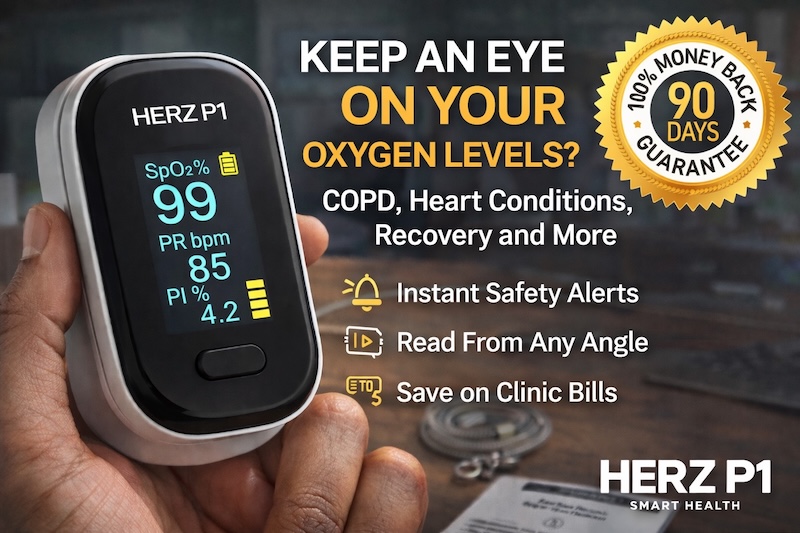
Smart Alarm Alerts: An alarm system that triggers when SpO2 or pulse rate readings move outside a set range. The listed default alarm threshold for SpO2 is below 90%, with customizable thresholds based on a doctor’s recommendations.
Dual-Color OLED Display with Six Orientations: SpO2 readings displayed in teal and pulse rate in amber, with a live pulse waveform and six display orientations for readability in different positions.
Accuracy Specifications: ±2% SpO2 accuracy in the clinical range and ±1 BPM pulse rate accuracy. The company frames these specifications as clinical-range accuracy as presented in its product materials.
Standalone Operation: No app, Bluetooth connection, charging cable, or subscription required. Batteries come pre-installed (2x AAA alkaline), with auto power-off after 8 seconds to preserve battery life.
Weight and Portability: Listed at 30g (1.06 oz).
The product is sold by Herz P1 LLC, registered at 839 E Market St, Ste 106 #165, Akron, OH 44305, United States.
You can find additional product details by viewing the current Herz P1 Smart Oximeter offer (official Herz P1 page).
FDA Regulatory Context: What “FDA 510(k) Cleared” Means and What You Should Verify
The Herz P1 product page displays the phrase “FDA 510K Cleared” as one of its featured specifications. This regulatory description warrants careful attention because it carries specific meaning in the medical device context.
For reference, these regulatory terms carry specific meanings:
FDA 510(k) clearance is a regulatory pathway for medical devices. Under this pathway, a manufacturer demonstrates that their device is substantially equivalent to a legally marketed device already on the market. Importantly, 510(k) clearance isn’t the same as FDA approval. It means the FDA determined that the device is substantially equivalent to a predicate device — not that the FDA independently validated the device’s clinical performance through its own testing.
FDA registration is a separate and distinct concept. Registration means that a manufacturing facility has registered with the FDA as required by federal law. Registration alone doesn’t indicate that any specific product manufactured at that facility has been cleared or approved by the FDA.
For anyone looking at the Herz P1’s regulatory descriptions, the distinction matters. The company’s product page describes the device as “FDA 510K Cleared.” However, the company’s own health disclaimer at the bottom of the same page states that the product and related services “are not intended to be used as a medical device or to replace professional medical advice, diagnosis, or treatment” and that the device is “for general wellness and fitness purposes only.”
This creates a positioning difference worth considering carefully. A device that has received 510(k) clearance would generally fall under the FDA’s medical device regulatory framework, while the health disclaimer distances the product from that framework. Verification of the specific 510(k) clearance number through the FDA’s 510(k) Premarket Notification database (accessible at accessdata.fda.gov) would allow you to confirm whether a valid clearance exists for this specific device.
At the time of this report, a 510(k) clearance number for the Herz P1 Smart Oximeter was not identified in publicly accessible FDA database searches and should be verified directly with the manufacturer. If FDA clearance status matters to your purchasing decision, confirm this directly with the company or through the FDA’s public database before ordering.
Accuracy Specifications in Context: What ±2% SpO2 and ±1 BPM Mean
The Herz P1 product page lists ±2% SpO2 accuracy in the clinical range and ±1 BPM pulse rate accuracy. The product materials describe these as aligning with commonly referenced clinical specification ranges.
For context, published pulse oximetry standards provide useful benchmarks. The ISO 80601-2-61 standard, which governs pulse oximeter performance testing, specifies accuracy requirements for clinical-use pulse oximeters. The FDA’s guidance for 510(k) pulse oximeter submissions references this standard and generally looks for an accuracy specification (expressed as Arms — root mean square error) of approximately 3% or better for SpO2 in the range of 70-100%.
A listed specification of ±2% SpO2 falls within the range that clinical-grade devices typically describe. However, there are important distinctions worth understanding:
Listed specifications versus validated performance are different things. A manufacturer listing ±2% on a product page is describing the device’s intended performance. The standard method for confirming whether a device achieves its stated accuracy is controlled hypoxia testing following ISO 80601-2-61 protocols. Without access to published test data or a verified 510(k) summary, you can’t confirm from publicly available information alone whether the stated accuracy has been validated through standard testing protocols.
The reference to hospital-grade device standards is a positioning description in the product materials. Hospital-use pulse oximeters from established medical device manufacturers undergo rigorous regulatory pathways, clinical validation testing, and quality management system audits. Whether a specific consumer-marketed device delivers equivalent real-world performance depends on validated testing data, not specification descriptions alone.
This context applies broadly to the consumer pulse oximeter category, not uniquely to the Herz P1. Many consumer-grade oximeters list similar accuracy specifications. Understanding the difference between a listed specification and validated performance helps you set informed expectations.
Smart Alarm Feature: How the Company Describes It
The Herz P1’s smart alarm system is presented as a key differentiating feature in the product materials. The alarm triggers when SpO2 drops below 90% or when pulse rate moves outside a set range, according to the product page. Thresholds can be customized based on a doctor’s recommendations.
The product materials include customer feedback describing user experiences with the alarm feature, including accounts referencing overnight oxygen drops and sleep-related discoveries. These accounts reflect individual experiences and are not intended to represent typical outcomes or medical conclusions. People who share feedback are self-selected, and satisfied customers are more likely to post than those with neutral or negative experiences.
If you’re considering any oximeter with alarm functionality for overnight monitoring, it’s worth understanding that continuous overnight pulse oximetry typically involves a device designed for extended wear. The Herz P1 is described as a clip-on fingertip device with an auto power-off feature activating after 8 seconds. If you’re interested in using the device for sleep-related monitoring, clarify how it functions during extended use directly with the company and discuss overnight oximetry options with your healthcare provider.
Product Pricing as Described on the Official Page
The Herz P1 Smart Oximeter is presented at a one-time price of $49.99. The company’s product page references percentage savings relative to what appears to be a higher listed reference price. Shipping is described as being fulfilled from a US warehouse with delivery in 2-3 business days.
Pricing was based on publicly available information at the time of this report and is subject to change. Current availability and pricing details are presented on the official product page. Verify current terms by viewing the current Herz P1 Smart Oximeter offer (official Herz P1 page).
Refund Policy and 90-Day Guarantee
Per the company’s published terms, Herz P1 orders are backed by a 90-day money-back guarantee. The product page describes the return process as hassle-free.
Specific return shipping requirements, documentation needs, and processing timelines should be confirmed directly with the company before purchasing. Customer support email is listed as [email protected].
It’s worth confirming the complete refund policy on the official website and retaining all purchase confirmation details before ordering.
Rewards Program Auto-Enrollment: What the Terms of Service Describe
The company’s Terms of Service include a section describing automatic enrollment in a rewards program upon purchase. Purchasing a Herz P1 product makes the buyer “automatically eligible” for Herz P1 LLC Rewards, described as providing shopping rewards in the form of cashback.
Activating these rewards requires linking a debit or credit card post-checkout within 30 days of purchase. The rewards program is powered by LIQUID Member Inc., and enrolled customers must comply with LIQUID Rewards’ separate Terms of Service.
Read the rewards program terms carefully before linking any payment information. Understanding what data is shared and with whom is important when any post-purchase enrollment involves financial account linking.
Customer Feedback on the Product Page: What You Should Understand
The product materials include customer feedback describing user experiences; however, these accounts reflect individual experiences and are not intended to represent typical outcomes or medical conclusions.
The company’s own advertisement disclosure states that the website “is an advertisement and not an actual news article, blog, or consumer protection update” and that “any results described or shown are based on individual experiences and may not be typical.”
Feedback describing specific medical outcomes — such as a device flagging overnight oxygen drops or a doctor adjusting treatment based on home readings — represents individual reported experiences. People who share their experiences are self-selected, and those who are satisfied are more likely to post feedback than those with neutral or negative experiences. These accounts shouldn’t be interpreted as guarantees of what any individual consumer will experience with the device.
Factor these disclosures into how you interpret feedback-based descriptions on the product website.
Consumer Verification Checklist: What to Confirm Before Ordering
Verify the FDA 510(k) clearance description. The company’s product page describes the device as “FDA 510K Cleared.” You can search the FDA’s 510(k) Premarket Notification database at accessdata.fda.gov to verify whether a specific clearance exists for this device. If a clearance number isn’t publicly listed, contact the company directly to request it.
Understand the difference between listed specifications and validated performance. A listed accuracy of ±2% SpO2 is a manufacturer specification. The standard method for confirming that specification is controlled testing following ISO 80601-2-61 protocols. Ask the company whether testing data is available.
Clarify overnight monitoring capabilities. If you’re considering this device for sleep-related oxygen monitoring, confirm with the company how the device functions during extended wear given its described auto power-off feature. Discuss overnight oximetry options with your healthcare provider.
Read the rewards program terms before linking payment information. The Terms of Service describe automatic rewards program enrollment upon purchase. Understand what the program involves before linking any debit or credit card information.
Confirm refund terms directly. Guarantee terms, return requirements, and processing timelines should be confirmed on the official website before purchasing.
Talk to your healthcare provider. No home pulse oximeter replaces professional medical guidance. If you’re managing COPD, heart conditions, or any respiratory concern, discuss home monitoring options — including which devices your care team recommends — with your healthcare provider before purchasing.
Who Might Consider the Herz P1 Smart Oximeter in 2026
Based on the product’s published positioning and described feature set, the Herz P1 may be of interest to adults looking for a standalone fingertip pulse oximeter that doesn’t require app connectivity, Bluetooth pairing, or subscription services — particularly those purchasing for elderly family members who prefer simple, single-button operation.
The product may be less suited for consumers who require verified FDA 510(k) clearance documentation before purchase, those seeking continuous overnight monitoring capabilities confirmed by the manufacturer, or individuals who need data logging, trend tracking, or smartphone integration features that the device doesn’t include.
As with any health monitoring device, individual experiences with pulse oximeters depend on factors including skin pigmentation, circulation quality, finger placement, ambient temperature, and nail condition. The FDA has issued guidance noting that pulse oximeters have inherent accuracy limitations that consumers should understand. Professional medical guidance should come before any purchasing decision for health monitoring equipment.
Consumer Questions About the Herz P1 Smart Oximeter
What is the Herz P1 Smart Oximeter?
The Herz P1 is a fingertip pulse oximeter sold by Herz P1 LLC. It measures SpO2 (blood oxygen saturation) and pulse rate, displays readings on a dual-color OLED screen, and includes a smart alarm feature that alerts users when readings move outside a set range.
Is the Herz P1 FDA cleared?
The company’s product page describes the device as “FDA 510K Cleared.” However, the company’s own health disclaimer on the same page states the product is “for general wellness and fitness purposes only” and is “not intended to be used as a medical device.” A 510(k) clearance number for this specific device was not identified in publicly accessible FDA database searches at the time of this report and should be verified directly with the manufacturer. You can also search the FDA’s 510(k) database at accessdata.fda.gov.
How accurate is the Herz P1?
The product materials list ±2% SpO2 accuracy in the clinical range (80-99%) and ±1 BPM pulse rate accuracy. These are manufacturer-listed specifications. The standard method for confirming whether a pulse oximeter achieves its stated accuracy is controlled testing following ISO 80601-2-61 protocols. If you want verified testing data, contact the company directly.
Can the Herz P1 be used for overnight sleep monitoring?
The product page includes customer feedback referencing overnight use and sleep-related discoveries. However, the device is a clip-on fingertip pulse oximeter with an auto power-off feature that activates after 8 seconds. Confirm with the company how the device functions during extended overnight use, and discuss continuous overnight oximetry options with your healthcare provider.
Does the Herz P1 require a smartphone or app?
No. The device is completely standalone — no app, Bluetooth connection, smartphone, or subscription needed. Data is read directly from the OLED display. The company suggests writing readings in a notebook for tracking over time.
What’s included in the box?
The package includes the Herz P1 Smart Oximeter device with batteries pre-installed (2x 1.5V AAA alkaline). It’s described as ready to use immediately upon opening.
Where is Herz P1 LLC located?
Herz P1 LLC is listed at 839 E Market St, Ste 106 #165, Akron, OH 44305, United States.
What is the return process?
The company describes a 90-day money-back guarantee. Specific return requirements and processing timelines should be confirmed directly with the company before ordering.
What is the rewards program mentioned in the Terms of Service?
Purchasing a Herz P1 product makes you automatically eligible for Herz P1 LLC Rewards, described as providing cashback rewards. Activation requires linking a debit or credit card within 30 days. The program is powered by LIQUID Member Inc. under separate terms. Read all terms before linking payment information.
Where is the Herz P1 available?
The company markets the product through its official website. You can find additional product details by viewing the current Herz P1 Smart Oximeter offer (official Herz P1 page).
Additional Consumer Research
If you’re researching the Herz P1 Smart Oximeter, you may benefit from previously published reporting on this brand. A 2026 report covering the Herz P1 brand and product details provides additional context on the company’s product line and how it is positioned in the market.
Research across multiple consumer publications, the FDA’s pulse oximeter safety communications, and peer-reviewed sources may provide broader perspective on home pulse oximetry, device accuracy standards, and what to look for when selecting a monitoring device. The FDA’s general guidance on pulse oximeters, including its 2021 safety communication about accuracy limitations, is publicly available on fda.gov. Consulting multiple sources is recommended before making any purchasing decision for health monitoring equipment.
Contact Information
For questions before or during the ordering process, the following customer support channels are listed on the company’s website:
Email: [email protected]
Phone (US): (877) 309-3614
Phone Support Hours: 9:00am – 5:00pm Eastern, Monday – Friday
SMS: +1 (888) 256-4198
Company Address: Herz P1 LLC, 839 E Market St, Ste 106 #165, Akron, OH 44305, United States
The company notes that email provides the fastest response time and that phone lines may experience high call volumes.
View the current Herz P1 Smart Oximeter offer (official Herz P1 page)
Disclaimers
Editorial Disclaimer: This article is for informational purposes only and does not constitute medical, health, or professional advice. The information provided reflects publicly available details from the Herz P1 website and general industry context. This report outlines how the product is described by the manufacturer. Always verify current terms, specifications, and regulatory descriptions directly with Herz P1 LLC before making purchasing decisions.
Medical Device Disclaimer: Pulse oximeters are screening tools that provide estimated measurements. They are not diagnostic devices and do not replace professional medical evaluation, diagnosis, or treatment. The FDA has issued safety communications noting that pulse oximeters have limitations including potential inaccuracy related to skin pigmentation, poor circulation, and other factors. Always consult a qualified healthcare provider before making medical decisions based on pulse oximeter readings.
Regulatory Descriptions Disclaimer: All regulatory descriptions referenced in this article — including “FDA 510K Cleared” and clinical-range accuracy specifications — are attributed to the company’s published product page. A 510(k) clearance number for this specific device was not identified in publicly accessible FDA database searches at the time of this report and should be verified directly with the manufacturer. Consumers are encouraged to confirm regulatory descriptions through the FDA’s publicly accessible 510(k) Premarket Notification database at accessdata.fda.gov or by contacting Herz P1 LLC directly.
Results May Vary: Individual experiences with pulse oximeters vary based on factors including skin pigmentation, peripheral circulation quality, finger placement technique, ambient temperature, altitude, nail condition, movement during measurement, and other individual variables. Accuracy specifications listed by the manufacturer have not been independently verified by the publisher.
FTC Affiliate Disclosure: This article contains affiliate links. If a purchase is made through these links, a commission may be earned at no additional cost to the buyer. This compensation does not influence the accuracy, neutrality, or integrity of the information presented.
Pricing Disclaimer: All prices, promotional offers, and shipping terms mentioned were accurate based on publicly available information at the time of publication (April 2026) but are subject to change without notice. Always verify current pricing and terms on the official Herz P1 website before making your purchase.
Publisher Responsibility Disclaimer: The publisher of this article has made every effort to ensure accuracy at the time of publication based on publicly available information. Readers are encouraged to verify all details — including regulatory descriptions, accuracy specifications, and refund terms — directly with Herz P1 LLC and their healthcare provider before making decisions.
Comparative Claims Notice: The title of this article includes the phrase “Best Pulse Oxygen Monitor Device on the Market,” which reflects how the manufacturer positions this product in its marketing materials. This phrase does not represent a determination by the publisher, nor is it based on comparative testing or market analysis conducted by the publisher. Consumers are encouraged to compare multiple pulse oximeter options and consult healthcare providers when selecting monitoring devices.
CONTACT: Email: [email protected]
Phone (US): (877) 309-3614
Phone Support Hours: 9:00am - 5:00pm Eastern, Monday - Friday
SMS: +1 (888) 256-4198
 Disclaimer: The above press release comes to you under an arrangement with GlobeNewswire. UKNewshour.com takes no editorial responsibility for the same.