Janitorial Wages Rise 26.7% in Five Years as Employers Face 321,800 Openings a Year, Nassco Analysis Finds

BLS data show median janitorial pay increased from $13.98 an hour in 2020 to $17.71 in 2025, while most projected openings over the next decade are expected to occur due to replacement needs rather than net job growth.
NEW BERLIN, Wis., Sept. 28, 2026 /PRNewswire/ — Nassco, Inc.’s analysis of national wage and employment data finds that the median hourly pay for janitors and building cleaners increased 26.7% between May 2020 and May 2025, while the U.S. Bureau of Labor Statistics projects approximately 321,800 openings in the occupation each year from 2025 through 2035. The figures provide context for facility managers evaluating how floor-cleaning work is staffed, measured, and supported by equipment.
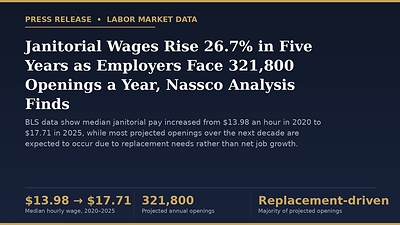
The U.S. Bureau of Labor Statistics, May 2020 report on Occupational Employment and Wage, found that the national median/average hourly wage for cleaners and janitors, excluding maids and housekeeping cleaners, was $13.98 in May 2020. By May of 2025, the janitors and building cleaners’ hourly median wage had reached $17.71, or $36,840 annually, according to the BLS Occupational Outlook Handbook. The 26.7% increase is calculated from the two published median hourly wage figures. The BLS figures are national occupational benchmarks rather than measures of individual facility costs. They also do not include every employer expense associated with cleaning labor.
At the same time, BLS projects 2% employment growth for janitors and building cleaners between 2025 and 2035. Employment is projected to increase from 2,432,600 jobs in 2025 to 2,486,200 in 2035, representing approximately 53,600 additional jobs. Despite the modest net growth, BLS projects about 321,800 openings per year over the decade, resulting from workers transferring to other occupations or leaving the workforce.
For facility operators, the combination of higher median wages and substantial replacement hiring activity creates a reason to examine cleaning workload more closely. The relevant question is not simply how many workers a facility employs, but how much floor area must be serviced, how often it must be cleaned, and which equipment fits the work.
Janitorial Pay Reached $17.71 an Hour in May 2025
The BLS Occupational Outlook Handbook reported a $17.71 May 2025 median hourly wage for building cleaners and janitors, with a corresponding annual median of $36,840. Compared with the May 2020 median of $13.98 reported by the BLS Occupational Employment and Wage Statistics program, the 2025 figure represents a calculated 26.7% increase. This comparison establishes a national wage trend rather than a direct measure of the total cost of cleaning operations. Employer costs can also include benefits, payroll taxes, scheduling, supervision, equipment, supplies, and training.
Pay also varies by employer category. In May 2025, the BLS reported median hourly wages of $20.76 in government, excluding state and local education and hospitals; $18.63 in educational services; $18.35 in healthcare and social assistance; and $17.21 in services to buildings and dwellings.
The variation reinforces the importance of using facility-specific labor and workload information when evaluating floor-care operations.
321,800 Annual Openings Reflect Replacement Needs
The BLS projection of 321,800 annual openings does not mean that 321,800 jobs are currently vacant. Instead, BLS expects most projected openings to occur due to replacement needs. Workers are expected to transfer to other occupations or leave the workforce, including through retirement.
The occupation’s total employment is projected to grow by only 2% from 2025 to 2035. The large number of annual openings alongside modest net employment growth reflects recurring replacement activity rather than rapid expansion.
Janitorial work also spans multiple facility types. BLS reports that in 2025, approximately 35% of janitors and building cleaners worked in services to buildings and dwellings, 17% in educational services, 7% in healthcare and social assistance, and 5% in government, excluding state and local education and hospitals.
These environments can have very different floor areas, traffic patterns, cleaning frequencies, and operating schedules. Equipment requirements need to be considered in relation to the individual facility.
Cleaning Workload Can Be Measured Before Equipment Is Selected
The ISSA (International Sanitary Supply Association) guidance on calculating cleaning times provides a framework for converting floor area into estimated task time. In one ISSA example, a 14-inch flat mop with a dual-chamber bucket has a production rate of 5,355 square feet per hour. Under that specified setup, 1,000 square feet equates to approximately 11.2 minutes of cleaning time.
ISSA describes its cleaning times as benchmarks that can support bidding, labor budgeting, and workloading. They are not time-motion studies, and actual results can vary by organization and operating conditions. That distinction is important when applying workloading to floor-equipment decisions. Production can vary with floor conditions, obstacles, room configuration, setup requirements, equipment characteristics, and operator experience.
The calculation nevertheless provides a repeatable starting point. A facility can identify its cleanable floor area, determine the relevant task and production rate, estimate task hours, and compare the result with actual staffing and labor costs.
ISSA Cleaning Times Includes Modern Equipment Categories
ISSA’s eighth edition of The Official ISSA Cleaning Times added equipment data covering walk-behind vacuum units, autoscrubbers, and microscrubbers, alongside revised cleaning times.
The ISSA announcement for the eighth edition in 2023, current resource remaining in use in 2026, states that the updated resource includes new equipment data and industry-specific cleaning information. The addition of equipment-specific data supports a workloading approach in which equipment is treated as one variable within the broader cleaning process. It does not establish a universal productivity multiplier for a particular machine. Instead, equipment can be incorporated into task-level cleaning-time estimates when the relevant production information and operating conditions are known.
Facility Workload Can Shape Floor-Equipment Selection
Nassco, Inc. offers several types of floor-cleaning equipment, including autonomous scrubbers, rider and stand-on scrubbers, walk-behind scrubbers, burnishers, floor machines, and sweepers. As these machines are designed for different cleaning tasks and facility conditions, equipment selection can start with the workload the facility needs to manage. Factors such as cleanable square footage, floor type, cleaning frequency, congestion, obstacles, route repeatability, staffing, storage, and charging requirements can help determine which type of equipment is appropriate for the space.
A walk-behind machine may be considered differently from a rider or stand-on machine when available floor area, maneuverability, and traffic conditions differ. Autonomous equipment introduces additional considerations, including route repeatability, operating environment, charging, and deployment.
Service, maintenance, and training can also affect the practical suitability of equipment. Nassco’s janitorial equipment service and repair program includes planned maintenance, replacement parts, installation, and training. Equipment does not automatically reduce labor costs, and purchasing a machine does not establish a guaranteed return on investment. Any change in labor requirements depends on utilization, task fit, and whether staff time can be productively redirected.
Rising Wages Make Facility-Specific Workloading More Relevant
The 26.7% increase in the national median hourly wage between May 2020 and May 2025, according to the U.S. Bureau of Labor Statistics, provides a measurable indicator of the change in the direct wage component of janitorial work. The BLS projection of 321,800 annual openings through 2035 provides separate context on recurring replacement activity.
Neither statistic demonstrates that rising wages or replacement hiring causes facilities to purchase floor-cleaning equipment. They also do not establish a particular labor saving from any machine. However, they do provide a basis for examining how much labor is assigned to recurring floor-care tasks.
A facility can begin by measuring cleanable floor area and cleaning frequency, identifying the tasks performed, estimating task time using appropriate production benchmarks, and comparing those requirements with actual staffing and labor costs. Equipment options can then be evaluated against the facility’s physical and operational conditions. The result is a facility-specific approach to floor-care planning rather than an assumption that one equipment category or productivity rate applies to every site.
Methodology
This analysis synthesizes U.S. Bureau of Labor Statistics Occupational Employment and Wage Statistics data for May 2020, BLS Occupational Outlook Handbook wage and employment data for 2025 through 2035, and ISSA guidance on cleaning-time and workloading calculations.
The 26.7% wage increase was calculated from BLS median hourly wages of $13.98 in May 2020 and $17.71 in May 2025 using the formula (17.71 / 13.98 – 1) × 100.
The analysis also incorporates ISSA’s worked example using a 5,355-square-feet-per-hour production rate for a specified 14-inch flat mop and dual-chamber bucket setup. ISSA production rates are benchmarks and should not be treated as guaranteed results.
Nassco’s floor-equipment offering is used for client and product-category context only. No proprietary Nassco customer survey, labor-savings study, ROI dataset, or equipment-performance dataset was supplied. National BLS figures should not be interpreted as Wisconsin-specific or as representing Nassco customers. No causal relationship between wage increases, replacement hiring, and equipment purchases is claimed.
Frequently Asked Questions
How much have janitorial wages increased since 2020?
Janitorial wages increased 26.7% based on the national median hourly wage reported by the BLS. The median rose from $13.98 per hour in May 2020 to $17.71 per hour in May 2025. This is a national occupational comparison, not a measure of what Nassco customers specifically pay cleaning employees.
Why does the BLS project 321,800 janitorial openings a year if employment grows only 2%?
BLS projects 321,800 annual openings primarily because of replacement needs. Workers are expected to transfer to other occupations or leave the labor force, including through retirement. The figure represents projected openings rather than the 321,800 currently unfilled jobs.
How can a facility estimate whether floor-cleaning equipment will save labor time?
A facility can calculate its cleanable square footage and divide it by a production rate appropriate to the specific task and equipment. The resulting task time can then be compared with actual staffing and labor costs. Site conditions, floor type, obstacles, setup time, maintenance, cleaning frequency, and operator practices can affect actual results.
How should a facility choose between walk-behind, rider, and autonomous floor scrubbers?
A facility should consider cleanable square footage, congestion, route repeatability, cleaning frequency, floor type, staffing, storage, charging, and service requirements. These factors help determine which equipment category fits the work pattern. A machine suited to large open areas may not be appropriate for a congested facility with frequent route changes.
Does buying floor equipment automatically reduce labor costs?
Buying equipment does not automatically reduce labor costs. Equipment can change the time required for a defined cleaning task, but the financial effect depends on utilization, task suitability, and whether staff time is actually reduced or productively redirected. Facilities should use their own workload and labor-cost data when evaluating potential benefits.
About Nassco, Inc.
Nassco, Inc. is a janitorial solutions provider founded in 1955 and based in New Berlin, Wisconsin. The company provides commercial cleaning and floor-care equipment, including autonomous, rider, and walk-behind scrubbers, burnishers, floor machines, and sweepers. Its floor-equipment offering is organized around facility needs, equipment type, and operational requirements, with consultation, training, and service support.
More information is available at Nassco, Inc.
Contact: Media Relations
Email: [email protected]
 View original content to download multimedia:https://www.prnewswire.co.uk/news-releases/janitorial-wages-rise-26-7-in-five-years-as-employers-face-321-800-openings-a-year-nassco-analysis-finds-302891899.html
 Disclaimer: The above press release comes to you under an arrangement with PR Newswire. UK Newshour takes no editorial responsibility for the same.