Joseph’s Well Atmospheric Water Generator Claims Evaluated: 2026 Consumer Research Report Examining DIY Water-From-Air Systems, Household Water Preparedness Trends, and Public Information About the Joseph’s Well Program


A 2026 consumer research report examining atmospheric water generation technology, household preparedness planning trends, and publicly available information about the Joseph’s Well DIY atmospheric water generation program.
Aurora, CO, March 13, 2026 (GLOBE NEWSWIRE) — This article contains affiliate links. If a purchase is made through these links, a commission may be earned at no additional cost to the buyer. This article is a consumer research report for informational purposes only and does not constitute professional, engineering, safety, or emergency preparedness advice. All product details are stated as presented by the company and should be verified directly on the official website before any purchasing decision. Individual results vary based on local humidity, build quality, and environmental conditions.
Recent geopolitical developments in the Middle East, including the February 2026 escalation involving Iran and the resulting disruption in the Strait of Hormuz shipping corridor, have renewed public discussion around supply chain resilience and household preparedness planning. Analysts monitoring energy markets note that oil price volatility often influences transportation costs, agricultural inputs, and broader supply chain stability. As these discussions expand, some households have begun researching independent water generation technologies — including atmospheric water generation systems that produce water directly from ambient air humidity.
Atmospheric water generation (AWG) systems — technologies designed to condense moisture from ambient air into usable water — have been explored for decades in military research, humanitarian projects, and commercial equipment development. As public awareness of these systems grows, several instructional programs and consumer guides have emerged that explain how small-scale versions of these systems may be constructed.
One program currently circulating across preparedness and homesteading communities is the Joseph’s Well program. Joseph’s Well represents one example of a digital instructional program that explains how small-scale atmospheric water generation systems may be assembled using commercially available components, according to the company. This consumer research report examines the technology category, the company’s public claims, and the information buyers should verify before making a purchasing decision.
Search interest in phrases such as “Joseph’s Well system,” “water generator from air,” and “DIY atmospheric water generator” has increased across preparedness and homesteading forums as household resilience planning has entered broader public discussion. This report addresses those search queries with verified, publicly available information.
Current program details, pricing, and included materials can be reviewed by viewing the current Joseph’s Well program details on the official website.
Individual results will vary based on local relative humidity, ambient temperature, component quality, power availability, and build execution. Joseph’s Well is a DIY educational guide, not a finished appliance. Output figures are stated as published by the company and are not guarantees of performance.
Household Water Preparedness Trends: Context for This Research
Household water preparedness planning has grown steadily as a category of consumer interest over the past several years. USGS data documents ongoing groundwater depletion across major aquifer systems, including the Ogallala Aquifer spanning the Great Plains and the Colorado River watershed serving the American Southwest. Approximately 60 million Americans rely on private wells for household water — a population for whom water supply concerns are not abstract.
The 2026 geopolitical situation has introduced a new dimension to these existing discussions. Energy market volatility following developments in the Strait of Hormuz has contributed to renewed discussion around supply chain resilience and household preparedness planning, with analysts noting downstream effects across agriculture, logistics, and broader supply chain operations. The UN World Food Programme has flagged long-term food and supply disruption risks tied to energy market volatility. While municipal water infrastructure is not directly tied to Middle Eastern shipping corridors, the visible demonstration of supply chain fragility has prompted renewed interest in household resilience planning across multiple resource categories — including water.
This context is relevant to understanding why search interest in water independence technology, including atmospheric water generation systems, has increased in early 2026. It does not imply that a household water crisis is imminent for most Americans — but it does explain the audience actively researching programs like Joseph’s Well and what questions they are bringing to that research.
Background: Atmospheric Water Generation Research and Technology
Atmospheric water generation is an established field of scientific and engineering research with documented applications across military, humanitarian, and commercial sectors. The underlying principle is condensation physics: when warm, humid air passes over a surface cooled below the local dew point, moisture in the air condenses into liquid water droplets that can be collected and filtered for use.
This is the same mechanism by which a cold glass develops condensation on a humid day, or by which a standard dehumidifier collects water from indoor air. The engineering challenge in AWG systems is making this process efficient enough to produce meaningful water volume at a practical energy cost.
Field deployments of AWG technology include Israeli military applications in arid desert environments — WaterGen, an Israeli company, has produced AWG units deployed in military field operations, disaster response, and humanitarian water access projects across Africa, South America, and Southeast Asia. The U.S. military has evaluated AWG technology through DARPA and related research programs. NASA has explored atmospheric moisture harvesting in the context of extraterrestrial water production research.
Commercial AWG units are available to consumers at price points ranging from approximately $1,500 for personal-scale units to $10,000 or more for high-output systems. Research into low-cost DIY AWG construction has appeared in engineering and sustainability communities, examining whether the core condensation mechanism can be replicated using widely available components at significantly lower cost.
The limiting variable in all AWG systems is ambient humidity. Output correlates directly with the amount of moisture available in the surrounding air. High-humidity environments — coastal regions, the American Southeast and Midwest, the Pacific Northwest — support meaningfully higher AWG output than arid environments such as the Desert Southwest. Any evaluation of AWG technology for household use must account for local climate conditions.
Overview of the Joseph’s Well Program
Joseph’s Well is a digital educational program sold by Direct Response SRL through ClickBank as the authorized retailer. The program is positioned toward preparedness-minded households, homesteaders, private well owners, and families seeking supplemental water generation capability independent of municipal or grid-based supply systems.
According to the company’s published FAQ — the most conservative and verifiable output figure provided on the site — the system described in the program is designed to produce up to 10 gallons of water per day under favorable humidity and temperature conditions. This report uses the FAQ figure as the reference point rather than higher figures referenced in some of the program’s marketing materials, as the FAQ represents what the company presents as a practical, real-world expectation.
According to the company’s published offer, the Joseph’s Well program includes the following materials:
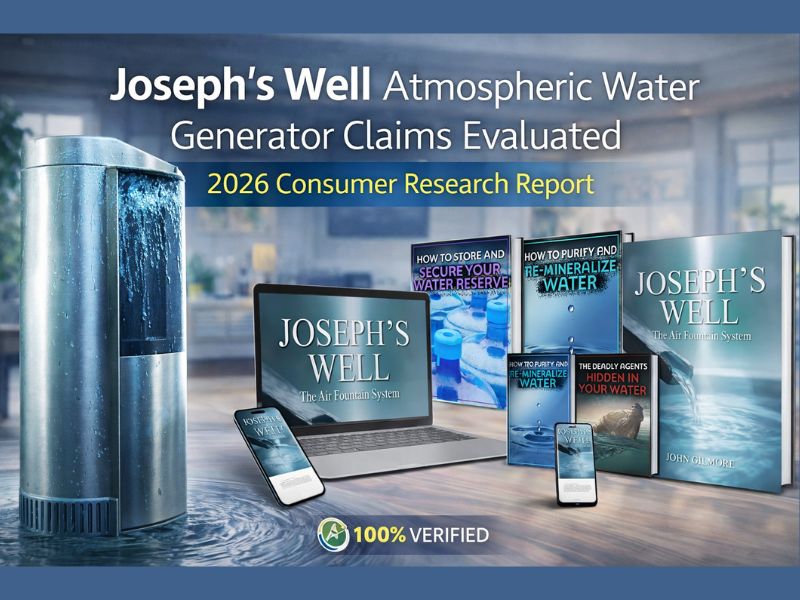
A complete step-by-step video guide covering the full build process from component selection through final assembly. Printable blueprints and schematics for reference during the build. A materials list with sourcing guidance. Instructions for both standard grid-connected power and an off-grid solar power configuration. Unlimited email access to support during the build process. Three bonus digital guides, covering water storage and reserve management, water purification and mineralization methods, and a report on common contaminants found in municipal water systems.
The program is delivered digitally. Access is available immediately after purchase. No physical device ships — the buyer assembles the system using the guide and locally sourced components. The company states that component costs for the build can be under $150 using widely available hardware store components, according to its published materials.
Current pricing and included materials are described on the official Joseph’s Well website.
Does Atmospheric Water Generation Work: Evaluating the Technology Claims
Search queries for “does Joseph’s Well work” and “does water generator from air work” reflect a reasonable consumer question: is the underlying technology credible, and does it perform as described?
Atmospheric water generation is the subject of published engineering research, commercial development, and field evaluation. The condensation principle on which AWG systems operate is well documented in engineering literature. Published research and commercial deployment indicate that output can vary materially based on humidity, temperature, system design, and operating conditions — the question for any specific implementation is output volume under local conditions.
What the research also establishes clearly is that output depends heavily on local humidity levels. A system operating in coastal Louisiana at 85 percent relative humidity will produce significantly more water than the same system operating in Phoenix, Arizona at 15 percent relative humidity. This is not a limitation specific to Joseph’s Well — it is a fundamental characteristic of all AWG systems. Prospective buyers in arid climates should research local average humidity levels before purchasing any AWG instructional program or commercial unit.
Energy consumption is a real operational variable. The cooling mechanism required for condensation draws electrical power. The Joseph’s Well program addresses an off-grid solar configuration, with the company stating the system can operate from a basic car battery and small solar panel. This is consistent with how low-draw cooling systems function, but the cost of a solar power setup is separate from the sub-$150 component estimate for the water generator itself. Buyers planning an off-grid build should factor this into total project cost.
Build quality affects output. Because Joseph’s Well is a DIY instructional guide rather than a finished tested appliance, results will vary based on the builder’s mechanical experience, component quality choices, and local operating conditions. Two households following the same instructions will not necessarily achieve identical results. The company’s 60-day satisfaction guarantee, per its published terms, provides a refund pathway if the program does not deliver as described.
What the Company States and What Buyers Should Independently Verify
The Joseph’s Well program is presented through a founder narrative centered on a character named John Gilmore, described in program materials as a husband, father, and off-grid builder who developed this system after losing well water access during an Arizona drought.
The program’s own Terms of Service states, verbatim: “John Gilmore is a pen name.” The site discloses that the company uses pen names for writer privacy and to draw on expertise across multiple areas. This is a standard practice in digital direct-response marketing, and the company’s decision to disclose it in published legal terms represents more transparency than many comparable programs offer. Buyers should understand they are purchasing a digital educational guide from Direct Response SRL, sold through ClickBank as the authorized retailer — not a product personally developed and sold by a named individual.
This disclosure is consumer context — it does not speak to whether the AWG technology described in the program is sound, or whether the instructions produce a functional result.
Additional claims worth verifying independently before purchase: The program references Israeli military AWG development as technological context — AWG does have documented military field application, as noted in the technology background section above. Some of the program’s marketing materials reference output figures higher than the FAQ’s 10-gallon-per-day figure — the FAQ figure is the more conservative and verifiable number to plan around. The sub-$150 build cost estimate applies to the water generator components specifically and does not include solar power setup costs if pursuing the off-grid configuration.
Testimonials referenced in program marketing represent individual experiences. The company’s own disclaimer states that these are not presented as typical results. Output variability across builders is a real factor in any DIY instructional program.
Regional Climate Considerations for Atmospheric Water Generation
Because AWG output is directly tied to ambient humidity, geographic location is one of the most important variables in evaluating whether this technology category is appropriate for a specific household. This section provides climate context for different regions of the United States.
Higher-humidity regions where AWG output is more viable: The Gulf Coast, Southeast, Mid-Atlantic, New England, Midwest, and Pacific Northwest generally maintain annual average humidity levels above 60 percent for significant portions of the year. In these regions, AWG systems — whether commercial units or DIY builds — can produce more consistent output. The specific performance of any system in these areas will still vary by season and local microclimate.
Lower-humidity regions where AWG output is more constrained: The Desert Southwest — including Arizona, Nevada, New Mexico, and portions of California, Utah, and Colorado — experiences annual average humidity levels that can fall below 20-30 percent for extended periods. In these environments, AWG output drops significantly and may not meet household supplemental water needs at the output levels the company describes. Buyers in these regions should research average humidity for their specific location and evaluate whether alternative supplemental water solutions may be more appropriate.
Seasonal considerations: Even in higher-humidity regions, winter months typically bring lower humidity levels that reduce AWG output. Buyers planning to rely on a DIY AWG system as a year-round supplemental source should evaluate performance expectations across seasonal humidity ranges for their area, not just peak summer humidity.
Local humidity data is publicly available through the National Oceanic and Atmospheric Administration (NOAA) and through state climatological office resources. Researching this data before purchase is a practical step for any prospective buyer.
Who This Technology May Be Relevant For
This consumer research report is most useful when it helps readers accurately assess whether the Joseph’s Well program — and DIY atmospheric water generation as a category — aligns with their actual situation. The technology is not universally applicable, and honest self-assessment produces better purchasing decisions than any marketing materials can.
The Joseph’s Well program may be relevant for households that:
Rely on private wells in documented water-stressed regions. Private well owners in the Colorado River watershed, above the Ogallala Aquifer, or in Western states with prolonged drought history face water supply variability that is documented by USGS data. A supplemental water generation capability addresses a real and documented concern for this population.
Already maintain preparedness-oriented household systems. Households that maintain food storage, emergency power, and first aid supplies as part of a deliberate resilience planning approach may find supplemental water generation a natural addition to existing layered redundancy. Joseph’s Well is designed as one component in a multi-layer preparedness framework.
Are comfortable with hands-on DIY construction projects. The program requires following technical instructions, sourcing components, and executing an assembly process. Households with basic mechanical or electrical project experience are better positioned to complete the build successfully than those without prior DIY project experience.
Live in environments with sufficient ambient humidity. As established in the regional considerations section above, households in the Midwest, South, Southeast, Pacific Northwest, and eastern seaboard are located in climates where AWG output is more consistently viable.
Other supplemental water solutions may be more appropriate for households that:
Require a finished, tested, warrantied appliance. Commercial AWG units from manufacturers including WaterGen are tested devices with manufacturer warranties — not DIY builds. For households where plug-and-play reliability matters more than build cost, commercial units are the more appropriate category.
Are addressing immediate short-term emergency storage needs. FEMA guidelines recommend storing a minimum of one gallon per person per day for at least three days. Food-grade water storage solutions — barrels, stackable containers, bathtub inserts — address short-term emergency storage without requiring a build project and are available at lower cost points.
Are located in low-humidity arid environments. Households in the Desert Southwest where AWG output is significantly constrained may find solar-powered rainwater catchment systems or cistern-based storage more practical for their specific climate.
How the Joseph’s Well Program Is Delivered
The program is sold digitally through ClickBank and delivers immediate access after purchase. According to the company’s published materials, buyers receive the complete video build guide, printable blueprints, the component materials list, both grid-connected and off-grid solar configuration instructions, support email access, and the three bonus digital guides described earlier in this report.
The company’s published return policy describes a 60-day satisfaction guarantee, and readers may review those terms directly when evaluating the program. Order and billing inquiries are handled through ClickBank customer service.
Product and build support questions may be directed using the contact information provided in the Contact and Support section of this report.
View current Joseph’s Well program details and pricing on the official website
Research Summary: Key Findings From This Consumer Research Report
This consumer research report examined atmospheric water generation as a technology category, the Joseph’s Well program’s public claims, and the information relevant to a purchasing decision. The following summarizes the key findings.
On the technology: Atmospheric water generation is an established technology with documented military, humanitarian, and commercial applications. The condensation physics underlying atmospheric water generation are well documented in engineering research. Published research and commercial deployment indicate that output can vary materially based on humidity, temperature, system design, and operating conditions. The primary governing variable is ambient humidity — performance varies significantly by location and season.
On the program’s claims: The company’s FAQ figure of up to 10 gallons per day under favorable conditions is the most conservative and verifiable output reference on the site. Build costs under $150 apply to water generator components specifically, not including optional solar power setup. The program is a DIY educational guide, not a tested finished appliance. The founder narrative is presented under a pen name, as disclosed in the company’s own Terms of Service.
On fit assessment: Joseph’s Well may be more relevant to preparedness-oriented households in higher-humidity regions that are comfortable with DIY construction projects and are evaluating supplemental water generation as one layer in a broader resilience framework. It may be less relevant for buyers in arid climates, those seeking plug-and-play appliances, or those addressing immediate short-term emergency storage needs specifically.
On the current context: Renewed household interest in water independence and preparedness technology in early 2026 reflects a real shift in public discussion driven by visible geopolitical and supply chain developments. For households already engaged in preparedness planning, addressing water generation as a resource layer is a consistent and logical extension of that planning approach. A previously published consumer report on the Joseph’s Well program examined the program’s faith-based preparedness framing and water security context in greater depth for readers seeking additional background on the program’s positioning.
The company’s published return policy includes a 60-day satisfaction guarantee, which readers may wish to review directly when evaluating the program against their household’s needs and local conditions.
View the current Joseph’s Well program details on the official website
Contact and Support Information
Readers with questions about the Joseph’s Well program, order status, or return requests may use the following contact information, as published in the company’s official materials.
Product Support: [email protected]
Returns: Joseph’s Well Returns Department, 19965 E 35th Dr Suite 100, Aurora, CO 80011, USA
Order Support (ClickBank — Authorized Retailer):
Email: [email protected]
US: +1 800-390-6035
International: +1 208-345-4245
1444 S. Entertainment Ave., Suite 410, Boise, Idaho 83709, USA
Disclaimers
Editorial Disclaimer: This article is a consumer research report for informational purposes only and does not constitute professional advice of any kind, including legal, safety, engineering, electrical, or emergency preparedness advice. All product descriptions reflect publicly available information from the Joseph’s Well website and program materials at the time of publication (March 2026). Readers should verify all current details directly with the company before making a purchasing decision.
DIY and Safety Disclaimer: Building any electrical or water-related device involves inherent risks. The Joseph’s Well program is a DIY educational guide. Individual build quality, component selection, electrical safety practices, local building code compliance, and water safety testing are the sole responsibility of the builder. This report does not evaluate the safety of any specific build configuration. Consult a qualified electrician or licensed contractor for any electrical installation questions. Nothing in this article is intended to encourage unsafe building practices or non-compliance with applicable local codes and regulations.
Results May Vary: Individual results will vary based on local relative humidity, ambient temperature, component quality, power availability, seasonal climate conditions, and builder execution. Output figures referenced in this report reflect the company’s published FAQ (up to 10 gallons of water per day under favorable conditions) and are not guarantees of performance for any specific build or location.
Founder Identity Notice: Per the Joseph’s Well Terms of Service, “John Gilmore is a pen name.” The program is sold by Direct Response SRL through ClickBank as the authorized retailer. This disclosure appears in the company’s own published legal terms and is included here for full consumer transparency.
FTC Affiliate Disclosure: This article contains affiliate links. If a purchase is made through these links, a commission may be earned at no additional cost to the buyer. This compensation does not influence the accuracy, neutrality, or integrity of the information presented in this report. All descriptions are based on publicly available information from the official Joseph’s Well website and program materials.
Pricing Disclaimer: All pricing, promotional offers, bonus inclusions, and program details referenced were accurate based on publicly available information at the time of publication (March 2026) and are subject to change without notice. Always verify current pricing and terms directly on the official Joseph’s Well website before purchasing.
Publisher Responsibility Disclaimer: The publisher of this report has made every effort to ensure accuracy at the time of publication based on publicly available information. We do not accept responsibility for errors, omissions, or outcomes resulting from use of the information provided. Readers are encou
CONTACT: Support: [email protected]
 Disclaimer: The above press release comes to you under an arrangement with GlobeNewswire. UKNewshour.com takes no editorial responsibility for the same.