Wireless Temperature Sensors Market Size to Grow USD 4.99 Billion by 2035 | SNS Insider


The U.S. wireless temperature sensors market was valued at USD 0.54 billion in 2025 and is projected to reach USD 0.91 billion by 2035, growing at a CAGR of 6.16% from 2026–2035. Market growth is driven by increasing adoption in industrial automation, smart home technologies, and HVAC systems to improve monitoring, efficiency, and energy management.
Austin, March 09, 2026 (GLOBE NEWSWIRE) — Wireless Temperature Sensors Market Size & Growth Insights:
According to the SNS Insider, “The Wireless Temperature Sensors Market Size was valued at USD 2.29 Billion in 2025 and is expected to reach USD 4.99 Billion by 2035, growing at a CAGR of 8.11% over the forecast period of 2026-2035.”
Rapid Industrial Automation and Demand for Remote Monitoring to Augment Market Expansion Globally
The primary factors propelling the growth of the wireless temperature sensor market are expanding industrial automation space and growing demand for remote monitoring. Real-time temperature monitoring is being adopted by factories and processing facilities in an effort to increase output and reduce downtime. Wireless solutions reduce wiring costs and allow for system interaction with current IoT infrastructures, resulting in increased service flexibility. Additionally, their continued use in the oil and gas, power, and chemical industries, where efficiency and safety are top priorities, improves their adoption with applications monitoring in hazardous or uncomfortable working situations.
Get a Sample Report of Wireless Temperature Sensors Market Forecast @ https://www.snsinsider.com/sample-request/7591
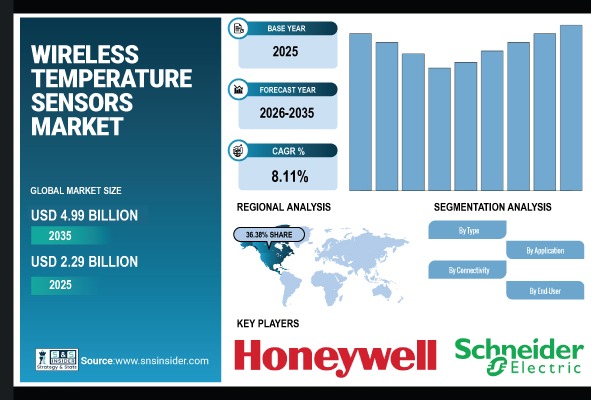
Leading Market Players with their Product Listed in this Report are:
- Honeywell International Inc.
- Schneider Electric SE
- Emerson Electric Co.
- Siemens AG
- ABB Ltd.
- Texas Instruments Inc.
- Analog Devices, Inc.
- Microchip Technology Inc.
- Yokogawa Electric Corporation
- Omega Engineering Inc.
- TE Connectivity Ltd.
- NXP Semiconductors N.V.
- Sensirion AG
- Bosch Sensortec GmbH
- Thermo Fisher Scientific Inc.
- Monnit Corporation
- Vaisala Oyj
- Swift Sensors, Inc.
- JUMO GmbH & Co. KG
- Axzon, Inc.
Wireless Temperature Sensors Market Report Scope:
| Report Attributes | Details |
| Market Size in 2025E | USD 2.29 Billion |
| Market Size by 2035 | USD 4.99 Billion |
| CAGR | CAGR of 8.11% From 2026 to 2035 |
| Report Scope & Coverage | Market Size, Segments Analysis, Competitive Landscape, Regional Analysis, DROC & SWOT Analysis, Forecast Outlook |
| Key Segmentation | • By Type (Thermocouples, Thermistors, Resistance Temperature Detectors, Infrared Temperature Sensors, Others) • By Application (Healthcare, Industrial, Automotive, Aerospace & Defense, Consumer Electronics, Others) • By Connectivity (Wi-Fi, Bluetooth, Zigbee, Others) • By End-User (Residential, Commercial, Industrial) |
Purchase Single User PDF of Wireless Temperature Sensors Market Report (20% Discount) @ https://www.snsinsider.com/checkout/7591
Key Segmentation Analysis:
By Type
Thermocouples segment dominated the largest share in the Wireless Temperature Sensors Market, accounting for approximately 38.05% of the global revenue in 2025, due to their broad range of temperatures and resilience and cost effectiveness. Thermistors are expected to register the fastest CAGR of about 9.67% from 2026 to 2035 because of the enhanced sensitivity and detection accuracy for the weak temperature variations.
By Application
The industrial segment dominated the largest share in the Wireless Temperature Sensors Market with a revenue share of about 31.92% in 2025, as it is heavily used in manufacturing, logistics and energy. Consumer electronics is projected to grow at the fastest CAGR of approximately 9.37% from 2026 to 2035, fueled by the smart devices and home automation wave.
By Connectivity
The Wi-Fi segment dominated the largest share of 38.49% in 2025, owing to its high data rate support and ease of integration with current networks. Bluetooth connectivity is projected to grow at the fastest CAGR of around 9.02% from 2026 to 2035, owing to low power consumption and ease of integration with mobile and wearable equipment.
By End-User
The industrial dominated the Wireless Temperature Sensors Market with a share of about 49.51% in 2025, due to the vigorous uptake in industries such as energy, logistics, and manufacturing. The residential segment is expected to expand at the fastest CAGR of approximately 9.12% from 2026 to 2035, with smart home usage only growing.
Regional Insights:
The North America region dominated the highest revenue share of 36.38% in the global market in 2025, supported by robust industrial infrastructure, early uptake of smart technologies, and a wide demand base across healthcare and manufacturing applications.
Asia Pacific is projected to expand at the fastest CAGR of approximately 9.44% from 2026 to 2035, due to the fast-paced industrialization, the growing demand for consumer electronics, and increasing spending on smart infrastructure.
Do you have any specific queries or need any customized research on Wireless Temperature Sensors Market? Submit your inquiry here @ https://www.snsinsider.com/enquiry/7591
Recent Developments:
- In December 2024, Emerson released the updated Rosemount 248 Wireless Transmitter with WirelessHART support, LCD diagnostics, and an extended-range antenna for efficient field temperature monitoring.
- In January 2025, Schneider expanded its EcoStruxure line with wireless temperature and humidity sensors for HVAC and energy systems, advancing smart building automation and environmental control.
Exclusive Sections of the Wireless Temperature Sensors Market Report (The USPs):
- TECHNOLOGICAL ADOPTION RATE – helps you understand the adoption rate of wireless temperature sensors across protocols such as BLE, Zigbee, LoRaWAN, Wi-Fi, and NB-IoT along with the penetration of battery-free and energy-harvesting sensor technologies across industrial, medical, and consumer applications.
- PERFORMANCE & RELIABILITY BENCHMARKS – helps you evaluate sensor accuracy ranges, measurement response time, wireless transmission range in indoor and outdoor environments, and signal stability metrics including packet loss rates.
- ENERGY EFFICIENCY & DEVICE LIFECYCLE METRICS – helps you analyze battery life expectancy under continuous and interval sensing conditions along with the growing focus on ultra-low-power ICs and edge intelligence for long-term sensor operation.
- PRODUCTION & CAPACITY UTILIZATION RATES – helps you identify manufacturing capacity utilization levels, production cycle time per unit, and yield rates in MEMS sensing elements and RF module assembly affecting supply availability.
- SUPPLY CHAIN & COMPONENT INTEGRATION INDEX – helps you understand component integration levels across SoC, antenna, and sensor fusion technologies along with localization trends in electronics and module sourcing across global manufacturing hubs.
- COMPETITIVE LANDSCAPE – helps you gauge the competitive strength of key players based on their R&D investments, patent activity in wireless sensing and power management technologies, product portfolios, and recent technological developments.
About Us:
SNS Insider is one of the leading market research and consulting agencies that dominates the market research industry globally. Our company’s aim is to give clients the knowledge they require in order to function in changing circumstances. In order to give you current, accurate market data, consumer insights, and opinions so that you can make decisions with confidence, we employ a variety of techniques, including surveys, video talks, and focus groups around the world.
CONTACT: Contact Us:
Rohan Jadhav - Principal Consultant
Phone: +1-315 636 4242 (US) | +44- 20 3290 5010 (UK)
 Disclaimer: The above press release comes to you under an arrangement with GlobeNewswire. UKNewshour.com takes no editorial responsibility for the same.