Cherokee learners connect generations with technology

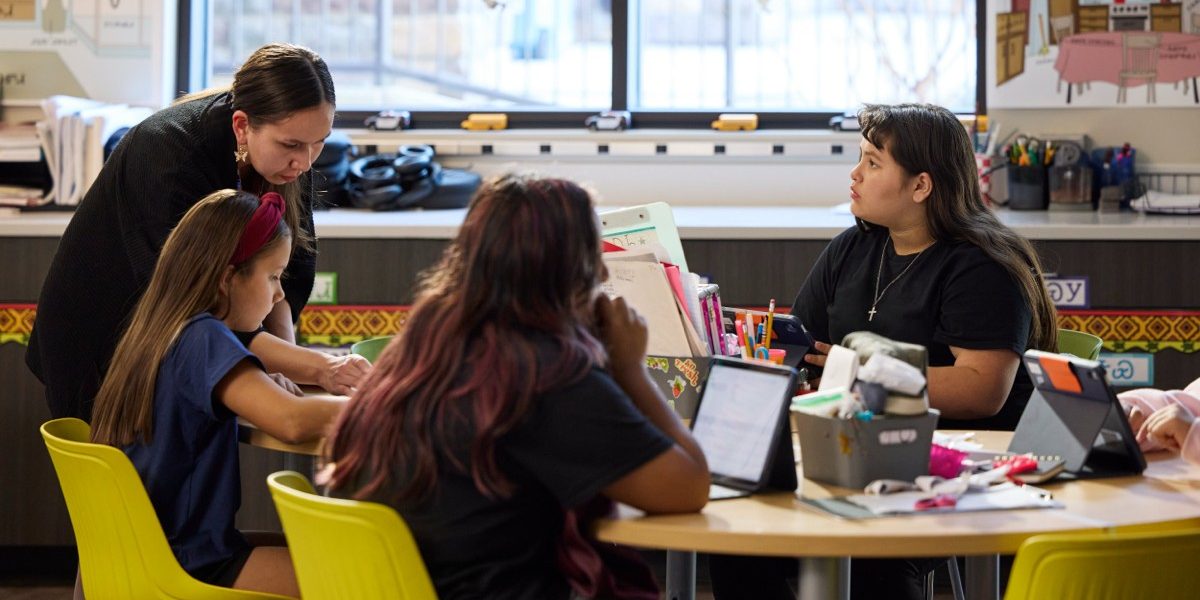
At the Cherokee Immersion School in Tahlequah, Oklahoma, youthful students buzz through hallways, transitioning from one class to another. This immersion institution, part of the Durbin Feeling Language Center, is committed to nurturing a new generation of Cherokee language speakers from pre-kindergarten to eighth grade.
“They’re really language warriors,” remarks Erlinda “Daksi” Soap, a fifth-grade instructor at the immersion school. “Our mission here at Cherokee Nation and the Durbin Feeling Language Center is to identify our future Cherokee leaders, who are eager to share and expand the language.”
Currently, the global Cherokee population exceeds 480,000 people, but there are fewer than 1,500 fluent speakers. In support of Cherokee Nation’s efforts to revive their language and culture, Apple, alongside Oklahoma City University (OCU), is equipping educators and students at the Cherokee Immersion School and Sequoyah High School with iPads and Macs through its Community Education Initiative.
Chuck Hoskin Jr., the Cherokee Nation’s principal chief, explains, “The technology we use with Apple has enabled us to advance the perpetuation and revitalization of Cherokee language and culture, making it relevant for our youth.”
Teachers such as Soap, Tyler Teague, and Jennie Pruitt have been chosen as technology ambassadors in this initiative, engaging in Apple and OCU-led training to seamlessly incorporate creativity and coding into their teaching, enhancing their reach to younger students.
In Soap’s classroom, an affirmation mirror promotes positive affirmations in Cherokee like “I am smart, I am loved, and I am strong” for students to practice, as they prepare for an upcoming Cherokee Language Challenge Bowl. “Initially, students wrote words on paper in pencil, but now they can record their pronunciation and review them at home,” Soap explains. She emphasizes the importance of precise pronunciation in Cherokee, noting that a single sound can alter a word’s meaning entirely.
In another classroom, Teague’s students finalize animated storytelling projects using Keynote and iMovie on their iPads. Storytelling remains a vital means of passing down language and cultural heritage among the Cherokee. Students also engage in creating an app to identify and document plant species, enhancing their understanding of traditional plant uses. Using Keynote, they draft app ideas and incorporate annotated environmental images into a custom machine learning model, eventually developing the app via Apple’s Swift Playground.
Teague highlights the advantages of using Keynote, “It allows students to add plant names, images, and record themselves pronouncing the names, capturing different community dialects.” He emphasizes the role of iPads in promoting literacy through typing in Cherokee and using the syllabary.
Hoskin praises the iPad as a revolutionary tool, stating, “It brings everything we’ve been building within reach of young Cherokees.” At Sequoyah High School, a new immersion track has been set up for graduates of the Cherokee Immersion School, enabling students like sophomore Olivia Daugherty, a 2024 graduate, to continue their language and cultural studies.
Reflecting on her earlier concerns about losing her language and culture, Daugherty shares, “Sequoyah offered Cherokee classes, which deepened my interest in conversational Cherokee.” She recalls learning the language from her father and immersing herself in it alongside her sister. In Pruitt’s Conversational Cherokee class, Daugherty practices basket weaving with elders, using art as a medium for cultural expression.
Pruitt introduces students to the origin story of the first fire in her weaving class, illustrating cultural narratives through activities like basket weaving. Students photograph baskets with iPads, using the images to design their own baskets in Freeform.
Pruitt notes the educational value of iPads, “They provide video and audio recording capabilities for podcasting and projects, making our language accessible through Cherokee fonts.”
In the STREAM lab, students design ribbon skirts using iPad and Apple Pencil before sewing them by hand. The lab also serves as a production space for the student-run podcast, Stories of Sequoyah. Teacher Melissa Fourkiller guides students in creating audio content, blending traditional crafts with modern technology.
Without Apple products, Cherokee Nation’s deputy principal chief Bryan Warner believes the language’s progress wouldn’t be as rapid. The Cherokee language’s written form, created over 200 years ago by Sequoyah, laid the foundation for bilingual newspapers and modern digital keyboards. Roy Boney Jr., a Cherokee artist, collaborated with Apple to integrate the syllabary into devices, calling it a connection between heritage and technology.
Hoskin remarks on this integration, “Having the syllabary on devices connects us with our past, now at the forefront of technology.” This empowerment is embraced by language advocates like Daugherty, who mentions her niece as a first-language Cherokee speaker, a rarity in recent generations.