
Europe Energy Week headlines Hannover Messe’s ‘Energy Day’, aligning energy systems with Europe’s industrial ambitions

- Discussions centred on industrial competitiveness, digital energy demand and the transformation of Europe’s energy systems
- Speakers included Stéphane Michel, President of Gas, Renewables & Power at TotalEnergies; Stefan Mecha, CEO of Volkswagen Nutzfahrzeuge; ND Maduemezia, President of Europe & Africa at SLB; Dr. Karl-Theodor zu Guttenberg, Former Federal Minister of Economic Affairs and Technology; and Dr. Gregor Gysi, Member of the German Bundestag
- Inaugural edition of Europe Energy Week to take place from 5-8 April 2027, co-located with Hannover Messe, the world’s leading platform for industrial and manufacturing innovation
- A strategic partnership between dmg events and Deutsche Messe AG, the event is designed to connect global energy supply, capital and technology with Europe’s industrial demand
HANNOVER, Germany, April 24, 2026 /PRNewswire/ — As ongoing geopolitical volatility in the Middle East continues to disrupt global markets and trade routes, the future of Europe’s industrial competitiveness and resilience increasingly depends on its ability to deliver integrated energy systems that can keep pace with rising demand.
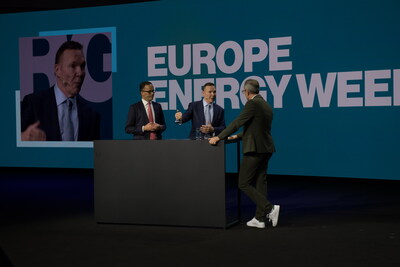
Against this backdrop, Europe Energy Week brought together senior leaders from across energy, industry and technology at Hannover Messe to examine how Europe can secure the reliable, affordable and scalable energy systems required to remain globally competitive.
Introduced ahead of its inaugural edition in April 2027, Europe Energy Week – developed by dmg events and Deutsche Messe AG – is designed to connect global energy supply, capital and technology with Europe’s industrial demand, enabling system-level coordination and delivery at scale.
Through a dedicated programme – including a panel discussion and live podcast – the platform created space for industry leaders to address the growing gap between energy supply and industrial demand.
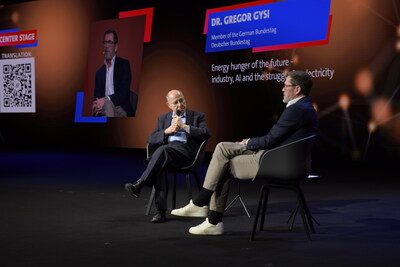
The programme opened with a special episode of “The Germany Podcast,” hosted by Dr. Karl-Theodor zu Guttenberg, Former Federal Minister of Economic Affairs and Technology, and Dr. Gregor Gysi, Member of the German Bundestag. The two experienced policymakers explored the ongoing evolution of Germany’s energy landscape, defined by fast-growing power consumption from industry and AI.
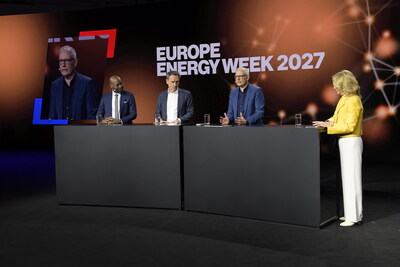
The podcast was then followed by a panel on “Energy Needs for Industrial Competitiveness in a High-Demand, High-Tech Future.” Participants included Stéphane Michel, President of Gas, Renewables & Power at TotalEnergies; Stefan Mecha, CEO of Volkswagen Nutzfahrzeuge; and ND Maduemezia, President of Europe & Africa at SLB.
Across both discussions, two clear messages emerged: energy systems are not scaling at the pace required to sustain Europe’s industrial competitiveness, and all forms of energy will be needed to meet the continent’s rapidly rising demand.
As industrial activity intensifies and the expansion of AI data centres continues to drive power consumption across Europe, speakers highlighted increasing pressuFgeore on infrastructure, the need to accelerate supply deployment and the importance of greater coordination across energy systems to ensure long-term stability. This challenge was reflected in the perspectives shared by industry leaders.
Stéphane Michel, President of Gas, Renewables & Power at TotalEnergies, said: “This reality is not new. The world of energy has always been defined by this trilemma: security of supply, affordability, and sustainability. If you want to survive and overcome crises, you need insurance, and in energy, this means overcapacity. Europe needs to import energy. That is a fact. But to do this, we need to support investment abroad…”
Speakers also pointed to the critical role of technology and investment in bridging the gap between supply and demand. From optimising existing infrastructure to accelerating the deployment of new energy systems, the focus is shifting from long-term ambition to near-term delivery.
ND Maduemezia, President of Europe & Africa at SLB, said: “Technology has a key role to play in compressing this gap and bringing supply to market quicker. There are many optimisation opportunities across existing energy systems, including in grids and storage, that could drastically improve supply speed and affordability. We need to start looking at Europe as one system with multiple components and understand how all these components can work together to support the larger system.”
The discussions underscore a broader shift: delivering energy systems that can meet rising demand is now central to Europe’s economic resilience and industrial future.
Europe Energy Week builds on this momentum. Taking place from 5-8 April 2027 in Hannover, Germany, and co-located with Hannover Messe, the event will convene global energy producers, investors, technology leaders and industrial users to align supply, infrastructure and capital with real demand.
Speaking on the event launch next year, Christopher Hudson, President of dmg events, emphasised the urgency of system delivery: “You cannot run tomorrow’s world on yesterday’s energy systems. As demand rises, the challenge is no longer just supply – it is how quickly and efficiently that supply can be delivered.
“This is no longer a sector issue – it is a system-wide challenge. Delivery depends on how well energy, infrastructure and demand are aligned. Europe Energy Week brings that alignment into one place, connecting the full value chain to accelerate delivery at speed and scale.”
Dr. Jochen Köckler, Chairman of the Managing Board at Deutsche Messe AG, reinforced the direct link between energy and industrial performance: “Manufacturing, and particularly smart manufacturing, is at the core of Hannover Messe. It is the world’s leading platform for industrial production. But production doesn’t run on technology alone.
“If you want to run a factory, if you want to enable future production, you need access to affordable and reliable energy. By uniting industry, energy and policy, Europe Energy Week will enable the right people to make the right decisions and ultimately ensure that business models remain competitive.”
Under the theme “Securing Energy. Powering Economies.”, Europe Energy Week will serve as the platform where dialogue translates into delivery – accelerating investment, enabling projects and strengthening the systems that underpin Europe’s long-term competitiveness in an increasingly complex global landscape.
About dmg events
Since 1989, dmg events creates connections that enable growth by bringing together global industries, governments and innovators to drive collaboration, unlock commercial opportunity and advance meaningful progress across the world’s most important markets. Through high-impact events and strategic partnerships, dmg events supports businesses and communities to navigate change, accelerate innovation and build sustainable success.
Operating from 13 offices worldwide, dmg events delivers more than 30 energy and policy events annually, enabling business growth across a range of key markets and sectors. Across four continents, its leading events, including ADIPEC and Gastech, bring together policymakers, industry leaders, investors and innovators to engage on the priorities shaping the future of energy systems and global markets. dmg events is committed to enabling a sustainable and resilient future by supporting cross-sector collaboration and addressing some of the world’s most pressing challenges.
Photo: https://mma.prnewswire.com/media/2965301/Europe_Energy_Week_Hannover_Messe_2026.jpg
Photo: https://mma.prnewswire.com/media/2965302/Europe_Energy_Week_Live_Podcast.jpg
Photo: https://mma.prnewswire.com/media/2965305/Europe_Energy_Week_Panel_Discussion.jpg
 View original content to download multimedia:https://www.prnewswire.co.uk/news-releases/europe-energy-week-headlines-hannover-messes-energy-day-aligning-energy-systems-with-europes-industrial-ambitions-302753018.html
 Disclaimer: The above press release comes to you under an arrangement with PR Newswire. UK Newshour takes no editorial responsibility for the same.
