
Rare Disease Genome Editing Market to Hit USD 12.60 Billion by 2035, Growing at a CAGR of 11.28% – SNS Insider


U.S. Rare Disease Genome Editing Market to Reach USD 3.60 Billion and Europe USD 3.42 Billion by 2035 as CRISPR Adoption, Gene Therapy Approvals, and Precision Medicine Drive Growth.
Austin, United States, Sept. 10, 2026 (GLOBE NEWSWIRE) — Rare Disease Genome Editing Market Size & Growth Analysis:
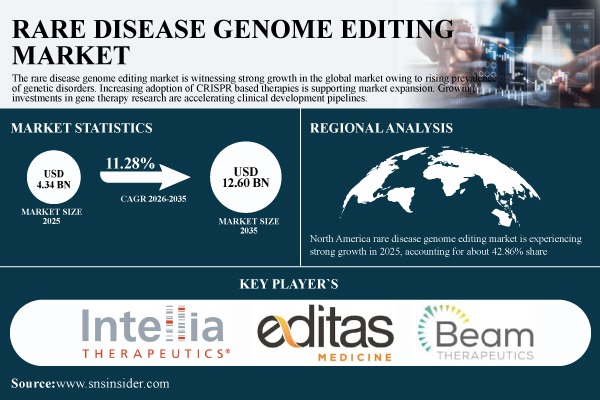
According to SNS Insider, The Rare Disease Genome Editing Market size was valued at USD 4.34 Billion in 2025 and is expected to reach USD 12.60 Billion by 2035, growing at a CAGR of 11.28% from 2026 to 2035. Growth will be propelled due to the increase in the frequency of genetic conditions, greater use of CRISPR therapy treatments, and increased funding in gene therapy research.
Use of AI and bioinformatics will improve gene discovery as well as allow quick identification of therapeutic targets, while increased genetic profiling will aid in personalized care for rare diseases.
Download the Rare Disease Genome Editing Market Sample Report: https://www.snsinsider.com/sample-request/10502
Rare Disease Genome Editing Market Key Highlights
- Market size, 2025: USD 4.34 Billion
- Market forecast, 2035: USD 12.60 Billion
- CAGR: 11.28% from 2026 to 2035
- Largest region: North America, approximately 42.86% share in 2025
- Fastest-growing region: Asia Pacific, approximately 13.39% CAGR
- Largest technology: CRISPR-Cas9, approximately 61.84% share in 2025
- Fastest-growing technology: TALEN, approximately 12.74% CAGR
- Largest application: Gene Therapy, approximately 54.33% share in 2025
- Fastest-growing application: Cell Therapy, approximately 13.83% CAGR
- Largest end-use: Pharmaceutical Companies, approximately 57.61% share in 2025
- Fastest-growing end-use: Research Institutions, approximately 13.96% CAGR
- Largest target disease: Cystic Fibrosis, approximately 38.92% share in 2025
- Fastest-growing target disease: Sickle Cell Disease, approximately 13.04% CAGR
Market Relevance
Rare diseases have been able to leverage genome editing due to its ability to effectively rectify disease-causing genes, offering a sustainable approach not available by other traditional forms of treatment. Over 1,500 rare diseases clinical trials are being conducted in the US, according to figures by the NIH.
Rare Disease Genome Editing Market Overview
The market consists of CRISPR-Cas9 and TALEN gene-editing technologies being used in gene and cell therapies for the treatment of cystic fibrosis, sickle cell anemia, and other rare genetic disorders by pharmaceutical firms and research organizations. CRISPR-Cas9 continues to dominate the market due to its high precision and clinical efficacy at relatively low costs, whereas TALEN is rapidly growing in importance due to its specificity and low off-target effects.
Strategic Market Outlook
Growth potential is seen in developments in precision medicine and personalized health care owing to increasing genetic profiling and use of AI in bioinformatics to discover therapeutic targets that are patient-specific. According to the EMA, more than half of the advanced therapy medicinal products clinical trials in 2024-2025 employ precision medicine techniques due to increased use of CRISPR technology and personalized genome editing.
The restrictive regulatory environment and ethical considerations are one of the key barriers to the adoption of such an innovation. Long validation period required by strict safety standards, ethical concerns related to germline editing as well as differences in regulation in different countries hinder the process of conducting multinational clinical trials and create hesitance among some investors.
Rare Disease Genome Editing Market Regional Analysis
North America has been found to be the largest market segment with 42.86% share in 2025 due to the presence of well-established biotechnology industry, high expenditure in drug research and development in the pharmaceutical sector, and early adaptation of CRISPR technology. The USA holds 78.45% revenue share in North America where 45% of the total gene therapy clinical trials were performed in the NIH database.
The U.S. Rare Disease Genome Editing Market was valued at USD 1.46 Billion in 2025 and is expected to reach around USD 3.60 Billion by 2035, growing at a CAGR of 9.47% from 2026 to 2035, with NIH-funded programs reporting over 3.2 million U.S.-linked human genomes sequenced to date.
The Europe Rare Disease Genome Editing Market had approximately 29.00% share in the overall market share in 2025 with the market size of USD 1.26 Billion and is estimated to reach USD 3.42 Billion by 2035 with CAGR of 10.50% during 2026-2035, driven by the robust regulation framework and increasing number of rare disease research. In Europe, Germany captured approximately 29.10% market share in 2025 and according to the estimates of Eurostat, 6 to 8% of the population of the EU is affected by rare disease, which equals about 30 million patients.
The Asia-Pacific is the fastest growing region, with the growth rate estimated to be 13.39% during 2026-2035, owing to the rapid development of biotechnological infrastructure and rising investments in healthcare industry. In 2025, China captured approximately 44.20% market share in Asia-Pacific and more than 35% of the rare diseases clinical trials in Asia Pacific region involve gene editing or gene therapy technology.
Middle East & Africa: The UAE accounted for approximately 19.30% of regional revenue in 2025, supported by improving healthcare infrastructure and rising awareness of rare genetic diseases.
Latin America: Brazil led regional revenue at approximately 48.10% in 2025, supported by growing biotechnology collaborations and healthcare modernization investment.
Buy the Rare Disease Genome Editing Market Report with Competitive Analysis and 2035 Forecast: https://www.snsinsider.com/checkout/10502
Rare Disease Genome Editing Market Segment Analysis
By Technology: The CRISPR-Cas9 technology held a market share of about 61.84% in 2025 due to the precise nature of gene editing it provides along with the affordability and quick results that it offers in clinical trials. The TALEN technology is the fastest growing market segment with a CAGR of about 12.74%, valued for its high specificity and lower off-target effects.
By Application: Gene Therapy held about 54.33% market share in 2025 owing to its ability to correct the genetic flaws responsible for rare genetic disorders. Cell Therapy holds the highest growth rate at a 13.83% CAGR due to the growing popularity of using engineered cells for treatment.
By End-Use: The Pharmaceuticals Company category held about 57.61% of the market share in 2025 due to huge investment in R&D and strong pipeline. Research Institutions is the fastest-growing category, holding about 13.96% CAGR, due to rising government funding and academic grants.
By Target Rare Diseases: In 2025, Cystic Fibrosis had a market share of approximately 38.92%, boosted by the increased prevalence and robust clinical studies. Sickle Cell Disease is currently the fastest-growing segment in terms of CAGR at 13.04%, backed by the increasing prevalence and approvals.
Rare Disease Genome Editing Market Key Trends
- Rapid adoption of CRISPR-Cas9 technology transforming rare disease treatment through precise gene correction
- Increasing clinical trials for gene editing therapies accelerating development timelines
- Integration of AI and bioinformatics enhancing gene discovery and therapeutic target identification
- Rising investments in precision medicine supporting personalized genome editing innovation
- Growing regulatory approvals for gene therapies encouraging wider adoption across healthcare systems
Competitive Landscape
The Rare Disease Genome Editing Market includes established gene editing pioneers and specialty biotechnology developers, with competition centred on CRISPR platform advancement and expanding rare disease indication pipelines.
In 2025, Intellia Therapeutics advanced NTLA-2001 and NTLA-2002 in clinical trials for transthyretin amyloidosis and hereditary angioedema indications. Beam Therapeutics progressed base editing programs including BEAM-101 for sickle cell disease through ongoing clinical development. In 2024, CRISPR Therapeutics advanced exa-cel regulatory approvals across multiple regions while expanding its Vertex partnership for sickle cell treatment rollout.
Major key players include
- CRISPR Therapeutics
- Intellia Therapeutics
- Editas Medicine
- Beam Therapeutics
- Sangamo Therapeutics
- Precision BioSciences
- Caribou Biosciences
- Prime Medicine
- Verve Therapeutics
- Mammoth Biosciences
- Scribe Therapeutics
- Tessera Therapeutics
- Metagenomi
- Vertex Pharmaceuticals
- Regeneron Pharmaceuticals
- Pfizer
- Novartis
- Roche
- AstraZeneca
- Sanofi
Explore the Complete Rare Disease Genome Editing Market Report: https://www.snsinsider.com/reports/rare-disease-genome-editing-market-10502
CONTACT: About Us:
SNS Insider is one of the leading market research and consulting agencies that dominates the market research industry globally. Our company's aim is to give clients the knowledge they require in order to function in changing circumstances. In order to give you current, accurate market data, consumer insights, and opinions so that you can make decisions with confidence, we employ a variety of techniques, including surveys, video talks, and focus groups around the world.

Contact Us:
Rohan Jadhav - Principal Consultant
Phone: +1-315-961-9094 (US)
Email: [email protected]
 Disclaimer: The above press release comes to you under an arrangement with GlobeNewswire. UKNewshour.com takes no editorial responsibility for the same.


