
TeamViewer study: 75% of employees use AI daily, but 61% want human oversight, indicating a confidence gap limiting progress

Global research from TeamViewer finds IT leaders expect nearly 40% of digital workplace services to run autonomously by 2030
GÖPPINGEN, Germany, July 22, 2026 /PRNewswire/ — AI is already part of everyday work, but organizations must close a confidence gap before they can unlock the next wave of AI productivity, according to new global research from TeamViewer, a leading provider of digital workplace solutions. While three quarters of respondents use AI daily, 61% still prefer human oversight before AI takes action — even as IT leaders expect nearly 40% of digital workplace services to run autonomously by 2030.
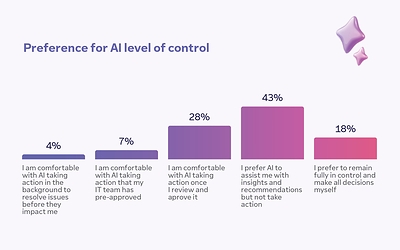
The global study ‘Path to the Autonomous Digital Workplace’ examines the shift from AI assistance, where people prompt tools and review outputs, toward autonomous systems capable of detecting needs and acting on them with progressively less human intervention.
Among the study’s key findings:
- AI is used daily. 75% of respondents use AI at least once a day, only 3% report no noticeable workplace benefits from using AI, and 64% describe their experience with AI as positive.
- The autonomous workplace is accelerating, especially in IT. 26% of IT leaders describe their departments as at least partially autonomous. 99% of IT leaders say they would be comfortable delegating at least one task to AI.
- Confidence drops as AI gains authority. 61% of total respondents prefer AI to take no independent action. While 35% are ready to allow AI to act more autonomously on their behalf, a majority of that group (71%) are only comfortable with AI handling defined tasks. Only 1 in 20 (5%) have no concerns about AI operating without a human in the loop.
- People do not reject autonomy; they reject invisible autonomy. 40% want AI to detect and fix issues early while keeping them informed, and 70% are comfortable with AI acting autonomously as long as they can step in when needed.
- Guardrails are central to trust. Respondents say autonomous action would be more acceptable with strong security and privacy protections (39%), notifications before major changes (36%) limits on what AI can access (36%), visible activity logs (33%) and rollback options (31%).
- People expect AI to reshape work, not eliminate it. By 2030, 33% expect AI to assist while they continue doing most tasks, 28% expect to delegate more tasks and focus on higher-value work, and only 2% expect their role to be eliminated.
The findings reveal what TeamViewer calls the AI Confidence Gap: people are increasingly comfortable using AI for assistance, but less ready to give autonomous systems greater access, authority and responsibility. That gap is already creating a verification burden. More than half of respondents (56%) often or always verify AI outputs before relying on them, spending an average of two hours per week checking AI-generated work, while 51% say they do not always know when to trust AI and when to verify it.
“AI is already changing how people work, but the next phase will be defined by trust,” said Oliver Steil, CEO at TeamViewer. “Organizations will not succeed by giving AI unlimited authority. They will succeed by building systems that operate safely, transparently and accountably within clearly defined guardrails. The real opportunity is to use AI and automation to prevent disruption, improve digital experiences, and free people to focus on higher-value work. Trusted autonomy, not unchecked automation, is what will unlock the next generation of productivity.”
IT is likely to be one of the first areas where autonomous systems take hold. Technology issues are often repetitive and measurable, which makes them easier to detect early, remediate automatically and, over time, resolve within defined guardrails. The survey supports this, as nearly all IT decision-makers surveyed (99%) would delegate at least one IT task to AI, most commonly system updates (61%), common device fixes (53%) and device performance adjustments (49%). This readiness reflects how far IT operations have progressed in a short time, and points to the continued move toward greater workplace autonomy.
“For years, software has largely been designed around what people tell it to do,” said Mei Dent, Chief Product and Technology Officer at TeamViewer. “Autonomous systems change that model. The next step is designing systems that know when to act, when to wait, and when to bring people into the decision. That requires clear guardrails, pre-approved actions, risk-based oversight, and transparency into what the system did and why. Autonomy will scale when organizations can prove it works in specific, trusted use cases, then expand it with confidence.”
About the Report
The study was conducted by Sapio Research on behalf of TeamViewer in April and May 2026, among 4,200 respondents across 9 markets: the U.S., the U.K., Australia, Brazil, France, Germany, Italy, Japan and Singapore. Respondents included an even split of managers and employees across industries and company sizes. The full report is available here.
About TeamViewer
TeamViewer (XETRA: TMV) resolves digital friction before it disrupts productivity. As AI compounds the sprawl of machines, applications, and agents beyond human reach, TeamViewer restores control: observing endpoint health in real time, acting autonomously to keep technology in its desired state, and guiding operators when human judgment is needed. Its TeamViewer ONE platform unifies endpoint management, digital employee experience, and agentic remote support to lead the shift to autonomous endpoint management (AEM). Built on a structural data advantage from millions of AI-captured expert resolutions, the platform powers self-healing technology and grows more capable with every issue it fixes. More than 600,000 customers, from small businesses to the world’s largest enterprises, rely on TeamViewer to keep their digital and physical operations running. Learn more at www.teamviewer.com.

 View original content to download multimedia:https://www.prnewswire.co.uk/news-releases/teamviewer-study-75-of-employees-use-ai-daily-but-61-want-human-oversight-indicating-a-confidence-gap-limiting-progress-302831549.html
 Disclaimer: The above press release comes to you under an arrangement with PR Newswire. UK Newshour takes no editorial responsibility for the same.
